
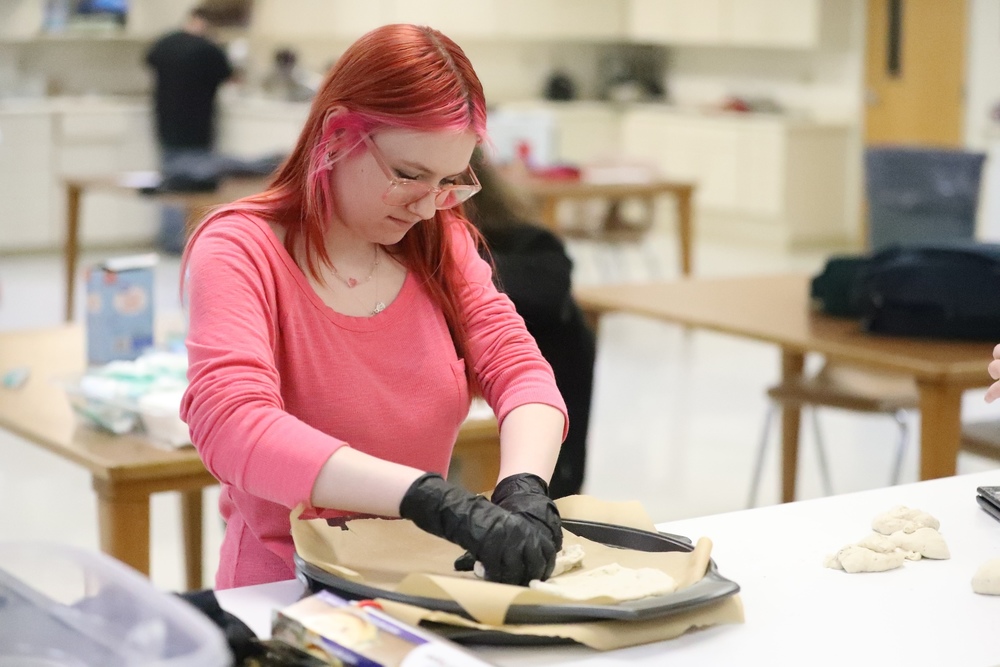
Written by Monika Spaulding
After years of not being offered, a new class is gaining popularity with students at Salem High School: culinary arts.
Stefanie Dean, who is teaching the class, said the suggestion to offer the class was brought up to her several years ago.
“The idea was pitched to me by using the culinary arts courses as a graduation option for the students who couldn't meet any of the requirements set out by the state,” she said. “They are life skills that many students don't get help with at home and it would help them get a diploma.”
Dean took the test to get licensed to teach the courses and then other things were happening in the corporation that took priority and the culinary arts program took a back seat.
“It came out in conversation that I was able to be licensed for those courses and Mr. (Luke) Dean helped me work with Prosser and the state to get the paperwork done in order to have those courses offered at SHS for the 2025-2026 school year,” she said.
Dean said she didn’t take culinary arts herself in high school, but she enjoys cooking and has always loved to bake.
“It wasn't something I wanted to make a career out of, but I love sharing my knowledge and learning new things along the way with them,” she said.
While they are still fine tuning the order of the classes for the program, as of right now, in order to meet the requirements for the pathway, students have to take several classes to complete the pathway.
The first is Principles of Culinary Arts for two semesters, which is a basic introduction to the world of food and the food industry.
Then they have to take a semester of Nutrition and Wellness. Dean said this course focuses primarily on the seven domains of wellness and biology of the things humans eat and drink.
“It's a nice combination of a health class and a biology class,” she said.
Next, students take a semester of Advanced Nutrition and Wellness, which Dean said is similar to the first semester of the class, but goes a step farther into how people are affected by national and global factors.
Lastly, is Culinary Arts, which is two semesters. This course will be taught next year to offer the capstone project (the cafe).
“The students this year have done a lot of leg work to get the kinks worked out for this course to happen next year,” she said. “The kids enrolled in this course will spend the majority of their time in the FACS room cooking or baking.”
Dean said she has enjoyed seeing the students learn new things and take pride in being able to be independent in a kitchen.
“They know more than they realize, they just didn't know that what they were doing could be applied to other types of meals or methods,” she said.
The most challenging part of starting the program has been time, according to Dean.
“Time to do what the students want to do versus what they need to do in order to meet requirements,” she said. “They have so many great ideas and a desire to learn how to cook certain things but they just don't have the time in a single class period to start and finish some of it. We are able to work around some of it, but they are restricted due to time.”
One of the projects the class has started this semester is making lunch for staff members. Dean said she was told that the previous teacher who taught culinary arts did it and staff members really enjoyed it.
“The kids are required to have some type of capstone in order to meet the requirements set out by the state,” she said. “When talking with the students about how they would like to see the program grow, they loved the idea of getting to put together meals every week.”
Dean said the students did 90% of the menu work.
“After they agreed that the cafe was the direction they wanted to go for their project, they had to do A LOT of back end work,” she said.
Students created an interest survey for the staff to fill out and then took that data and each student submitted a meal plan for three different types of cuisine.
“Each student was assigned at random a week this semester to be the head chef and one of the meal plans submitted by that person was randomly selected to be served,” said Dean. “If the student who was up for head chef did not submit appropriate plans last semester, then I fill in the gaps.”
Dean said there are currently 28 students enrolled in Advanced Nutrition and Wellness and Principles of Culinary Arts. A handful of the students are taking both courses currently. She hopes to see the program continue to grow.
“I think the students currently enrolled enjoy it most days and are excited to be in the kitchen,” she said. “They have put in so much work for it to be successful this year and next year. The school corporation and high school staff have also been so supportive for the entire endeavor.”
Dean said the pathway is a great option for students because everyone needs to know how to cook.
“Even if it is something as simple as pasta noodles,” she said. “Part of the beauty of this program is that we get to meet the students where they are individually on a skills based level. Some of them struggle with the basics, like peeling and cutting a potato. Other students need the challenge of making something more complex. We get to do that here.”